Here is an example of an AWR report generated from a benchmark test of an OLTP system:

In the Top 10 Foreground Events by Total Wait Time section, it shows that log file sync accounts for 48.3% of the total database time. This event occurs when a user session commits a transaction and must wait for the corresponding redo data to be written to the redo log files by the Log Writer (LGWR) process. The average write time for this event is 5.69 milliseconds, which is on the high side, as it typically should not exceed 2 milliseconds.
The second-largest wait event, log file switch (checkpoint incomplete), accounts for 28.2% of the total database time. This event arises when Oracle needs to switch to a new redo log file, but the checkpoint process has not yet completed writing the dirty buffers from the current redo log file to the data files. The fact that this event accounts for such a significant portion of the total database time is a major concern. Typically, this event should not appear in the top 10 wait events. Additionally, the approximately 2 seconds of average wait time for this event is abnormally high.
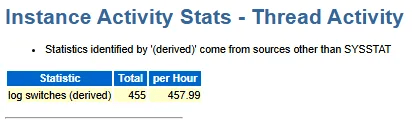
In the Instance Activity Stats - Thread Activity section, it is shown that there are 456 log switches per hour. Typically, a healthy range for log file switches during peak hours is once every 15 to 20 minutes. The observed the high frequency of log switches is evidently the root cause of the log file-related wait events, this has significantly eaten into Oracle performance.

The Load Profile section indicates that this database generates 24,559,056.7 bytes per second. To bring the log file switch frequency into a healthy range. We increased the number of log file groups from 3 to 4, and increased the size of each log file from 200 MB to 22 GB, which can hold approximately 15 minutes of redo. After making these modifications, we reran the benchmark test.

The Top 10 Foreground Events by Total Wait Time section section of the AWR report for the rerun benchmark test shows that:
- The
log file switch (checkpoint incomplete)event disappeared from the top 10 wait events. - The average wait time for
log file syncdecreased significantly to approximately 0.5 milliseconds. DB CPUaccounted for 68.4% of the total database time, indicating that the database spent the most of its time doing productive work.
By increasing the size of log file, we successfully reduced the log file-related wait events, thereby enhancing the database’s efficiency and overall performance.


 Yuan Yao, An Oracle ACE's Blog
Leave a comment