This is Part 2 of a 3-part article series to explore CPU Hyper-Threading.
Part 1: What Is CPU Hyper-Threading?
Part 2: How Hyper-Threading Skews CPU Usage Readings
Part 3: Does Hyper-Threading Boost CPU Performance—and by How Much?
How Hyper-Threading Skews CPU Usage Readings
Because the operating system collects CPU usage metrics based on logical CPUs, it may report lower utilization percentages even when the physical cores are heavily taxed.
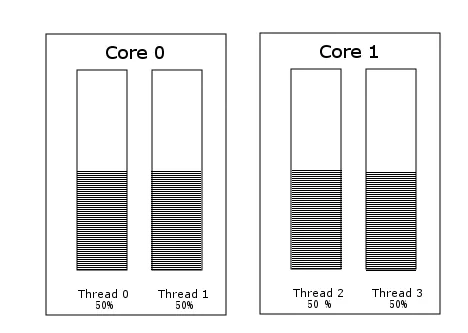
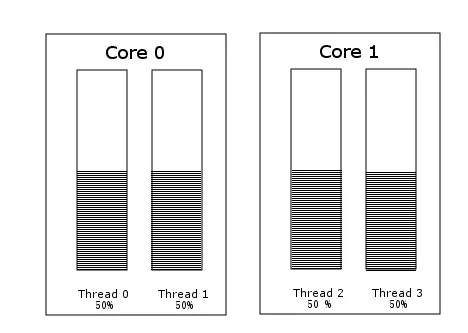
For example, consider a dual-core CPU with Hyper-Threading technology, resulting in four logical CPUs. If the CPU usage is at 50%, the workload could be distributed across these logical CPUs in several ways (though for conceptual simplicity, we illustrate three scenarios):
Scenario One: The workload is evenly distributed across the four logical CPUs of the two cores, with all four logical processors operating at 50% usage.
Scenario Two: Only one of the two cores is in use, with the two logical processors on that core at 100% usage, while the two logical processors on the other core are at 0% usage.
Scenario Three: Both cores are busy, with each core having one logical processor at 100% usage and the other at 0% usage.
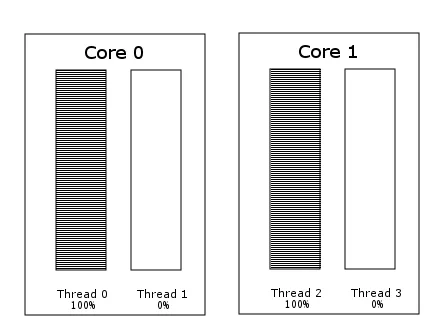
Modern operating systems, such as those developed since Windows 2000 and Linux 2.4, are typically optimized for Hyper-Threading technology. For instance, if only two threads are scheduled to run, the operating system tends to place them on logical processors that belong to different physical cores to minimize resource contention. This optimization makes Scenario Three more likely. In this case, it is unrealistic to expect a substantial workload increase when CPU usage approaches 100% because Hyper-Threading does not genuinely double the CPU’s capacity or performance. Consequently, even a modest increase in workload can lead to a disproportionate rise in CPU usage, significantly impacting response times.
While Hyper-Threading technology can increase parallel processing, it can also significantly distort CPU usage metrics. The distortion becomes more pronounced when more threads are accommodated in a single core. For example, IBM’s SMT supports eight threads per core, which can exacerbate the distortion even further.
For performance analysis purposes, CPU utilization percentages should always be evaluated relative to physical cores. For instance, on a sever with Hyper-Threading, if the operating system reports 30% CPU usage, it can be translated to 60% of the physical cores.
This is the end of Part 2. In Part 3, we’ll talk about Does Hyper-Threading Boost CPU Performance—and by How Much?


 Yuan Yao, An Oracle ACE's Blog
Leave a reply to CPU Hyper-Threading Explained: What It Is (Part 1 of 3) – Yuan Yao, An Oracle ACE's Blog Cancel reply